


In this Story
Share


In 2026, solar panels in India cost between 16 and 30 per watt, depending on the type of panel you choose. Newer TOPCon panels cost a little more upfront than older Mono PERC panels, but they generate more electricity and lose efficiency more slowly so they usually work out cheaper over the 25+ years your system will run. Price per watt is only the starting point. What really decides whether you save money is your total system cost, how much subsidy you qualify for, and how much electricity your panels generate over their lifetime.
If you're planning a rooftop system for your home or a larger setup for your business, this guide walks you through all of it that what price per watt actually means, what a full system costs, how much you can expect to save, which subsidies apply to you, and how to pick between the panel technologies on the market today.
What Does "Price Per Watt" Mean?
Solar panels are rated by how much power they can produce, measured in watts (W). Price per watt simply tells you how much you're paying for each watt of that capacity. It's how you compare panels of different sizes and brands on a level footing.
Price per Watt = Total Panel Cost / Panel Wattage
For example, The calculations are approximately correct: ₹11,210 ÷ 590 Wp = ₹19/Wp, and ₹7,480 ÷ 440 Wp = ₹17/Wp. Please display the ₹ symbol consistently and specify whether prices include GST and delivery. Also clarify that rated wattage is measured under standard test conditions and that price per watt alone does not establish lifetime energy output or value.
What Does a Full Solar System Actually Cost?
The panels are just one part of your bill. A complete solar system typically includes the inverter, mounting structure, electrical protection, cabling, installation, grid connection (for on-grid systems), commissioning and monitoring. Applicable taxes, including GST, are also part of the final price.
The total cost varies with system size, whether it is on-grid or off-grid, roof type, location, and the panel and inverter you choose. For commercial and industrial installations, costs can also depend on civil work, transformer or electrical upgrades, and ongoing operation and maintenance (O&M).
For detailed pricing tailored to your requirement, please reach out to us.
These are indicative figures. Your actual cost depends on your roof, location, panel choice and system design. Always ask for a full, itemized quote rather than comparing installers on the panel price alone.
How Much Can You Actually Save?
This is where panel choice matters most. Two systems of the same size can generate very different amounts of electricity and save you very different amounts of money over 25 years.
The biggest factor is how fast a panel loses output as it ages. Premier Energies backs its TOPCon panels with a 30-year performance warranty, well beyond the industry standard, because TOPCon cells are built to hold their output for longer. Over two decades, that gap can add up to a noticeably higher electricity bill with an older-technology panel even if it looked cheaper on day one.
Panel efficiency also affects your savings indirectly: a more efficient TOPCon panel produces more power from the same roof space, so you can often install a smaller, tidier system and still meet your electricity needs.
Subsidies You Can Claim
Homeowners installing rooftop solar can apply for support under the PM Surya Ghar Muft Bijli Yojana, the central government's rooftop solar subsidy scheme. To qualify for this and most other government-linked or grid-connected schemes, your panels generally need to meet two requirements:
- ALMM listing your panels must be on the Ministry of New and Renewable Energy's Approved List of Models and Manufacturers.
- Domestic Content Requirement (DCR) for subsidy and scheme eligibility, your panel's solar cells must be manufactured in India, not just assembled here. DCR-compliant panels typically cost a bit more, but this is what unlocks the subsidy in the first place.
Ask your installer to confirm both before you finalize a quote. A cheaper panel that doesn't qualify can end up costing you the subsidy.
Mono PERC vs TOPCon: Which Should You Choose?
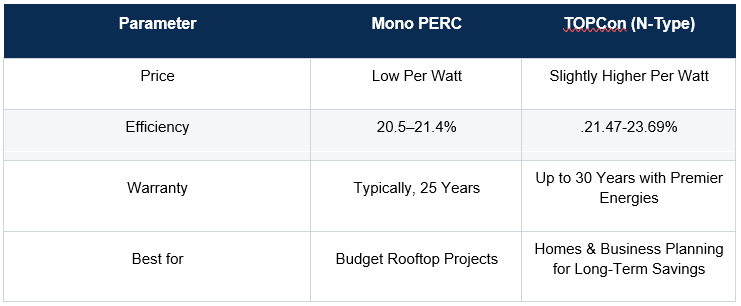
Mono PERC has been the standard choice for years, but it's an older generation of technology and is gradually being phased out as TOPCon becomes more affordable. If you're installing solar today, TOPCon is the technology built for where the market is heading. It costs a little more upfront but is the better long-term investment for most homes and businesses.
Why Premier Energies?
Premier Energies has manufactured solar panels in India since 1995 and now runs 11.1 GW of module manufacturing capacity, with cell capacity expanding to 10.9 GW. Its TOPCon cells are built on Zero Busbar architecture. A first for India which improves both output and durability, and its panels are backed by a 30-year performance warranty. Manufacturing is fully automated with AI-enabled defect detection, at India's first LEED Gold-rated solar production facility. The company is rated A+/A1 by CRISIL for financial stability and recognized as a Kiwa Top Performer for module reliability.
How to Choose the Right Panel?
Before you sign a quote, ask your supplier:
- Is this a Mono PERC or TOPCon panel?
- What's the power warranty and product warranty?
- Is it DCR-compliant, if you're claiming a subsidy?
- What's the panel's efficiency rating?
- What does the full, installed solar system cost?
Get the Right System for Your Home or Business
Price per watt is a useful starting point, but your real savings come from total system cost, subsidy eligibility, and how long your panels keep performing. For most homes and businesses, a TOPCon system backed by a longer warranty is the smarter long-term choice.


